Nevada AB 396 and Your Casita: What Las Vegas Homeowners Need to Know About the New Law
What Nevada AB 396 Actually Changed
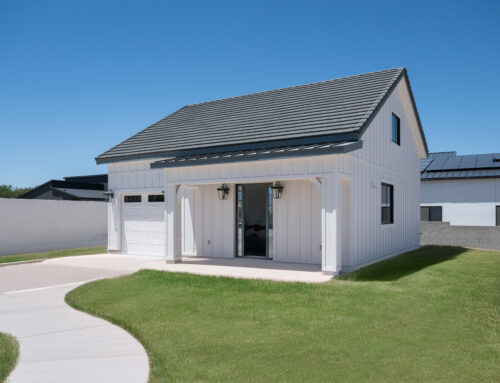
Before AB 396, casita rules in Nevada varied widely. Some jurisdictions prevented homeowners from building casitas with separate kitchens. Others required much larger lot sizes than the property could realistically meet. The law removes those barriers statewide. Cities and counties must now allow casitas on residential lots, with code language that follows AB 396’s framework. The Nevada legal definition of an accessory dwelling unit is consistent with how most homeowners think about a casita: a structure on the property of a primary residence (or as an addition to it) that has its own kitchen and bathroom. The kitchen requirement is the important part. It separates AB 396-eligible casitas from converted bedrooms, rec rooms, or bonus rooms that may have their own bathroom but not their own kitchen. Nevada is following a regional pattern. Arizona passed a similar ADU law in 2024. Several other states, including Arkansas, Iowa, and Maine, passed comparable laws in 2025, according to the Harvard Joint Center for Housing Studies 2026 State of the Nation’s Housing report. The shift toward state-level ADU legislation is one of the most consistent housing policy responses to the national affordability crisis.
How AB 396 Plays Out Across the Las Vegas Valley
Each Las Vegas valley jurisdiction has handled AB 396 compliance on its own timeline. Here is the current state of casita rules across the four jurisdictions that cover most of the valley, based on FOX5 Vegas reporting on AB 396 implementation. 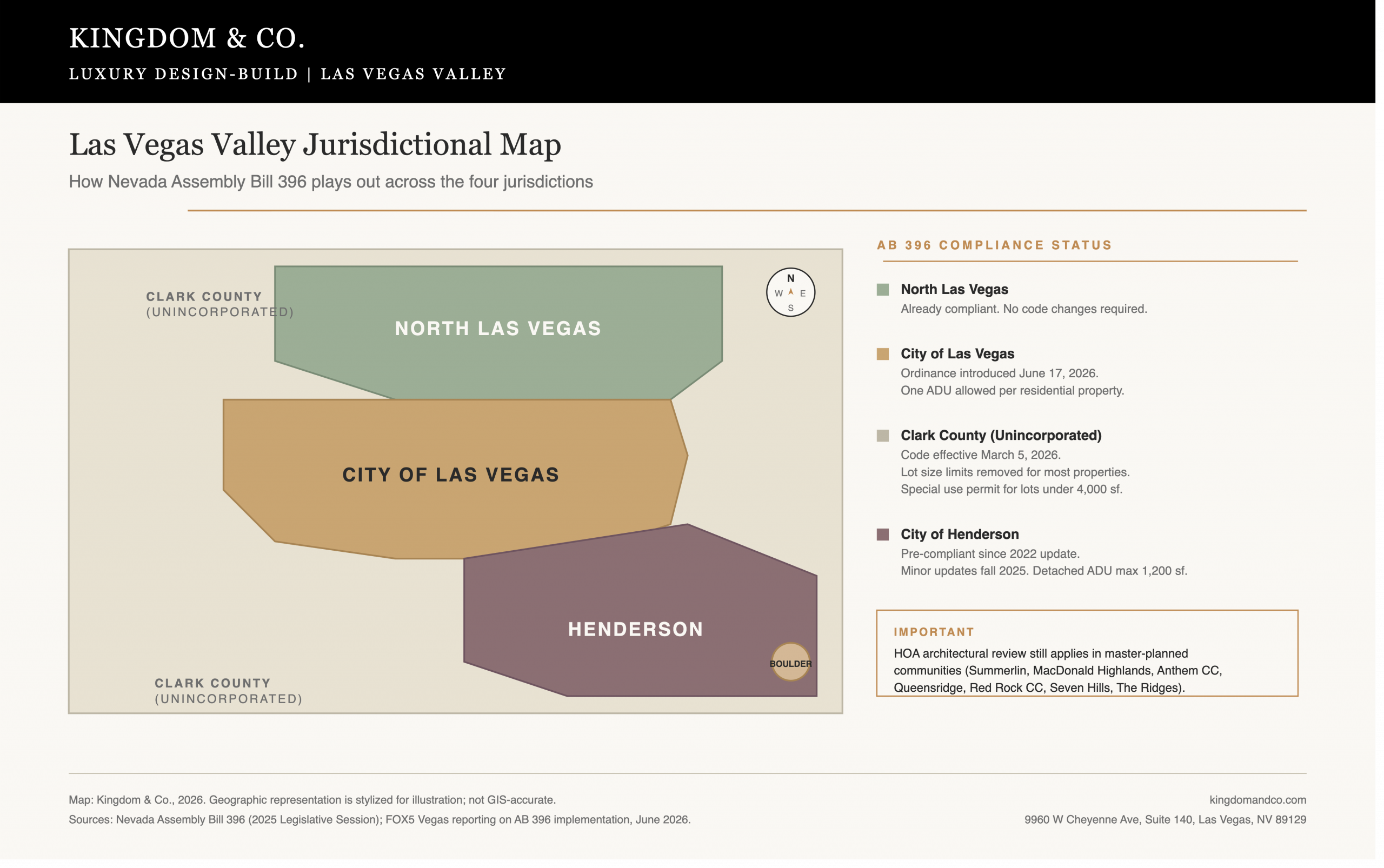
City of Las Vegas
The City of Las Vegas introduced an ordinance on June 17, 2026 to bring municipal code in line with AB 396. The ordinance clarifies setbacks, allowable ADU size, and minimum lot sizes. One important detail for City of Las Vegas property owners: the new ordinance allows only one residential accessory dwelling unit per property. Homeowners cannot stack multiple casitas on a single lot under the city’s compliance framework.
City of Henderson
Henderson got ahead of AB 396 by years. The city made sweeping changes to expand ADU options back in 2022, working from recommendations published by the American Planning Association. When AB 396 passed, Henderson only needed minor adjustments in the fall of 2025 to fully comply with the new state framework. For Henderson homeowners, the current code is largely the same code that has been in place since 2022, refined slightly to match the AB 396 language.
Clark County (Unincorporated)
Clark County’s casita rules apply to homes on unincorporated land, which covers significant parts of the Las Vegas valley including portions of Summerlin, Lone Mountain, and the broader northwest. The Clark County Board of Commissioners passed code updates that took effect on March 5, 2026. The biggest change: lot size limitations for accessory living quarters were removed. A special use permit is now required only for lots smaller than 4,000 square feet, or for properties within mobile or tiny home parks. Most Las Vegas valley luxury lots are well above that threshold.
North Las Vegas
North Las Vegas was effectively pre-compliant. City staff confirmed to FOX5 Vegas that the existing North Las Vegas code already met AB 396 requirements without changes. North Las Vegas homeowners can move forward under the current code without waiting for a new ordinance.
HOA Architectural Review Still Applies
This is the part that most online coverage of AB 396 has not addressed clearly. The state law simplified the municipal rules. It did not override homeowner association architectural review committees. If you live in one of the Las Vegas valley’s master-planned communities, the HOA architectural review committee still has final authority over what gets built on your lot. The communities where this matters most: Summerlin (all village-level ARCs), MacDonald Highlands, Anthem Country Club, Queensridge, Red Rock Country Club, Seven Hills, and the gated estate communities in The Ridges. In each of these, casita construction triggers ARC review covering exterior architectural elements: rooflines, materials, color palette, landscape integration with the primary residence, fence and gate integration, and the casita’s visual relationship to neighboring properties. AB 396 makes the casita allowable from a state and municipal perspective. The ARC still decides whether your specific casita design meets the community’s architectural standards. Kingdom & Co. has run casita projects through the architectural review committees of every major master-planned community in the valley. We handle the submission, the renderings, the material specifications, and the back-and-forth with the ARC as part of every casita project.
How Kingdom & Co. Navigates AB 396 for Clients
Building a casita under AB 396 is straightforward if you know the framework. The work breaks down into five phases:
- Site assessment: lot size, setbacks, existing structures, mechanical capacity (water, sewer, electrical) to determine what the lot can actually support
- Jurisdiction identification: City of Las Vegas, Clark County, Henderson, or North Las Vegas (each has a different permit submission path and review process)
- HOA architectural review coordination: applies in any master-planned community, requires renderings and material specifications, runs in parallel with the municipal permit
- Design that meets both local code and HOA standards: this is where most casita projects go right or wrong; the design has to satisfy two different sets of rules at the same time
- Permit submission and inspection management through completion: K&C handles all submissions, schedules inspections, and resolves any review comments without bouncing the work back to the homeowner
What AB 396 Means If You Are Already Planning a Casita (Or Have One)
If you already have an unpermitted casita
AB 396 may make it easier to legalize what you have. Some unpermitted casitas were built under prior rules that no longer apply. A site review with our team is the fastest way to confirm whether AB 396 changes anything about your situation. Legalizing an existing unpermitted casita through current code is almost always cheaper and faster than the alternative.
If you are planning a casita
AB 396 likely removes barriers that would have prevented your project under the prior code. The first conversation worth having is about your specific lot, your jurisdiction, and (if applicable) your HOA. From there we can develop a casita design that fits the lot, meets the rules, and supports the use you have in mind.
If you are buying a property and want to add a casita
Factor the lot size, the jurisdiction, and the HOA framework into your offer evaluation. Our pre-purchase walkthrough service exists for exactly this scenario. We tour the property with you and your real estate agent, talk through what is structurally possible, and give you an informed budget range so you can evaluate the property with construction data rather than guesswork.
The Casita Door Just Opened. Here Is What to Do Next.
Nevada AB 396 simplified the casita rules across every Las Vegas valley jurisdiction. The state-level barriers that prevented many homeowners from building are gone. What remains is the practical work: matching your lot to the right design, navigating the HOA review where it applies, and handling the permits cleanly. Kingdom & Co. has built casitas across Summerlin, Henderson, Centennial Hills, Lone Mountain, and the broader Las Vegas valley for the families who use them as in-law suites, home offices, art studios, and guest accommodations. The law just changed. The work itself has not.
Frequently Asked Questions
A casita is not the same as a tiny home, and the rules are different. A casita under Nevada AB 396 is a
permanent structure on the property of a primary residence, with its own kitchen and bathroom, built
to the same code as the primary home. A tiny home is typically a moveable structure, often on wheels or
a chassis, sometimes built to RV codes rather than residential building codes. Under Clark County’s AB
396-aligned framework, properties within mobile or tiny home parks have separate rules, and lots
smaller than 4,000 square feet require a special use permit. For most Las Vegas valley homeowners on
standard residential lots, a permanent casita is the better legal and structural option than a tiny home.
Yes. Every casita built in the Las Vegas valley requires a permit from the appropriate jurisdiction (City of
Las Vegas Development Services, Clark County, City of Henderson, or City of North Las Vegas). Plumbing,
electrical, and structural work all trigger permit requirements. If you are in a master-planned community
(Summerlin, MacDonald Highlands, Anthem Country Club, Queensridge, Red Rock Country Club, Seven
Hills, etc.), HOA architectural review approval is also required separately from the municipal permit.
Kingdom & Co. handles both submissions and all inspections as part of every casita project.
Maximum casita size under Nevada AB 396 is set by each local jurisdiction’s code. The state law
removed the largest lot-size barriers but left specific square-footage limits to municipalities. The City of
Henderson currently caps detached ADUs at 1,200 square feet, which is one of the clearest published
thresholds in the valley. Other jurisdictions (City of Las Vegas, Clark County, North Las Vegas) have their
own maximums depending on the specific ordinance language adopted under AB 396. The most
accurate answer for your specific property requires checking your jurisdiction and any applicable HOA
architectural review committee. Kingdom & Co. confirms the size limits for your specific lot and
jurisdiction during the discovery phase before design work begins.
Custom casita construction in the Las Vegas valley currently ranges from approximately $250 per square
foot at the entry level to $500 per square foot or more for luxury-finish builds (Picasa Homes industry
data, 2025). For a typical 1,200-square-foot detached casita built to luxury standards, total project cost
typically falls between $400,000 and $600,000+, including design, permits, site work, and finishes.
By size, the typical Las Vegas valley casita and addition pricing ranges look like this:
- 500 sq ft casita: $150,000 to $300,000
- 800 sq ft casita: $240,000 to $480,000
- 1,200 sq ft casita (Henderson maximum for a detached ADU): $360,000 to $720,000
- Room addition: $300 to $500 per sq ft of added space
- Second-story addition: $400 to $700 per sq ft of added space
Final pricing depends on lot conditions, finish level, HOA requirements, and design complexity. Every
Kingdom & Co. project starts with a complimentary in-home consultation where we develop a realistic
budget range for your specific scope and lot before any design work begins
Yes. Casita, in-law suite, and granny flat are all common names for what Nevada jurisdictions formally
call an Accessory Dwelling Unit (ADU). The Nevada legal definition of an ADU is a structure on the
property of a primary residence (or as an addition to it) that has its own kitchen and bathroom. The
kitchen requirement is what separates an ADU from a converted bedroom or bonus room. Nevada AB
396 uses the formal ADU terminology, but the law applies to anything most homeowners would call a
casita.