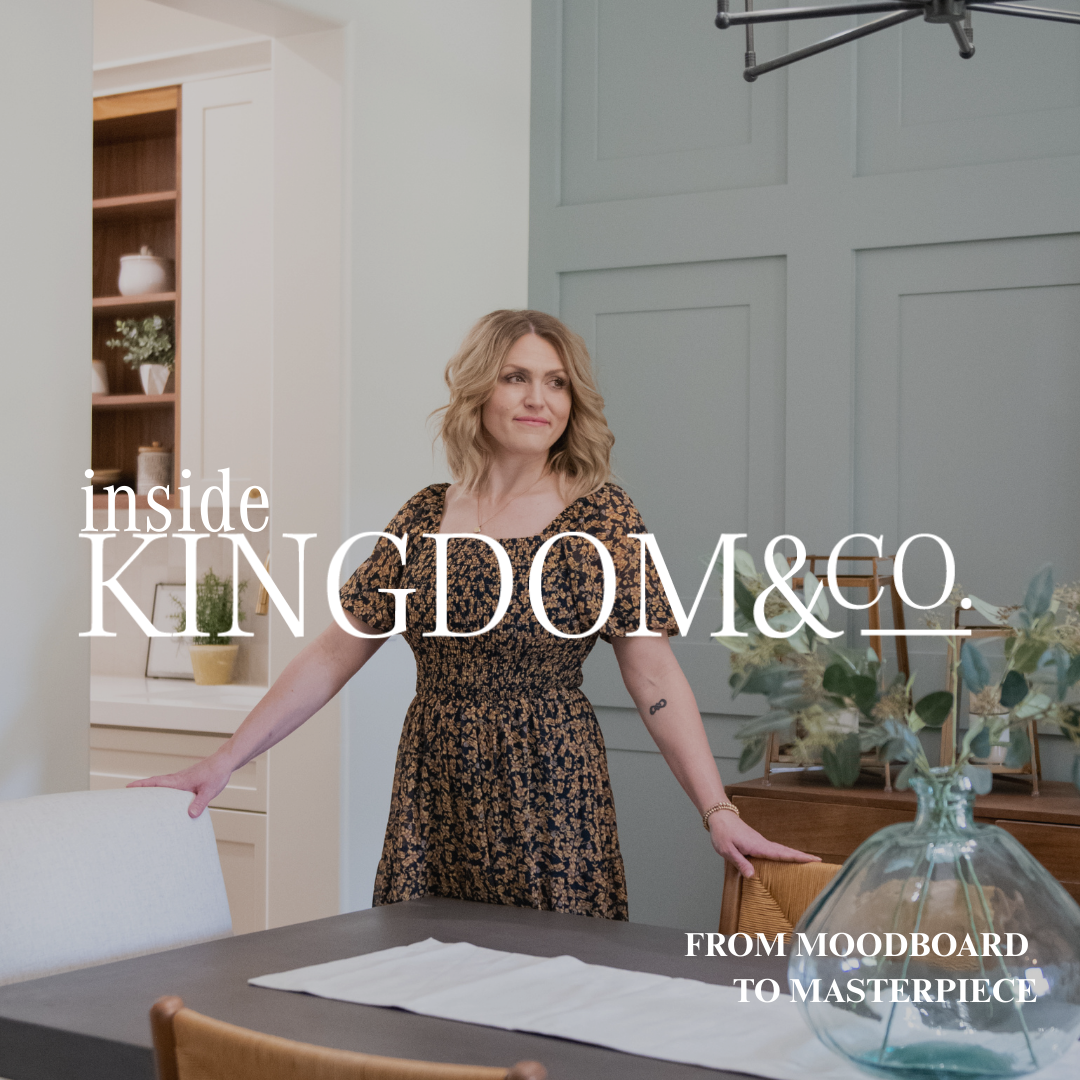
Inside Kingdom & Co.
Hosted by Brian Horner and Lincoln Rogers, we started this podcast to pull back the curtain on the design-build world. This podcast was born from a desire to bring clarity and confidence to a process that often feels overwhelming. Whether you're renovating, building from the ground up, or simply exploring your options, we're here to offer refined insight and trusted guidance. From navigating timelines and budgets to understanding design choices and construction challenges, this podcast is your guide to a smoother, smarter experience from concept to completion.
From Moodboard to Masterpiece
Welcome back guys, it’s a new year, 2026, and right now we are sitting in our conference room getting ready to discuss interior design with our pre-construction manager.
Krysti, we’ve mentioned this before in other things, but she has a ton of experience in every single department from our company.
She’s that type of person who’s, have you been here for six years now?
Seven years?
How long have you been here?
Niner?
I don’t even know.
But yeah, so she’s been here for a long time.
You’ve done every position, you’ve worked in every aspect of this company to the point where you took off as an interior designer.
You’re doing so well there that we pled with you to please lead our design team, and you’ve done a really good job in that position.
So, Krysti, one of the things we want to talk about today is what we do to people’s environments.
Like, how do we change people’s lives?
Like, it sounds kind of silly because, you know, it sounds like we’re like, I don’t know.
We change people’s environments, which does change people’s lives.
So explain to us, like, what goes into what we do and the results of it, if that makes sense.
Yeah, so, I mean, we’re dealing with, you know, people’s homes, which they’re in every single day, and our goal is to make it, you know, so they love the home that they’re in, so their day-to-day becomes better in every way.
So even, not just like the paint or things like that that make it feel better, but functionality-wise as well, making it so it’s easier to live in their home, so they become, you know, more calm and just enjoy being there.
For me, I’m very passionate about this, personally, because I love design.
I’m not good at it, but I love it.
When I’m in my home and my office, like, I remember designing the office and really putting, you know, we put in a rug, we put in a couch, we did an accent wall, we added art and made it, like, a very clean vibe, and I remember just thinking, when I go into that office every single day, my headspace is clear.
All the natural lighting from the windows, and it just, I enjoy the space to where I feel like life is about to, I truly believe that our life is about being, you’re supposed to enjoy life.
And if you’re in an environment where it’s dark, gloomy, dated, scuff marks everywhere, garbage everywhere, I just feel like you can’t have the headspace.
It stresses you out.
It stresses you out.
Like, our goal as a design team and as Kingdom & Company, we really thrive off of really improving people’s environment.
And we like, and how we get to do that is we get to know the clients first.
So we really try to ask them questions and figure out, like, what is, what are you trying to get out of your space?
What’s more important?
Do you want it to feel good?
Do you want it to just look good?
You know, so you feel good in it, or does it need to be super functional for you?
And that way, also, we can help guide them in their budget and where best to spend their money in order to get that perfect space for them.
The value engineering, there’s three functions to it.
There’s value engineering, which is helping people stick to their budget.
Then there’s functionality, which is making sure the space is functional.
And then the third, which is, to me, one of the most important things, is the beauty of the whole thing.
Exactly, yeah.
So that makes a lot of sense.
And I love that that’s what we do to people’s environments.
Is there a story or somebody that comes to mind where they were just so happy after a project that you worked with?
Like, is there just, is there some, like, what’s the first part that comes to mind of, like, an environment that you changed where you were like, you were proud of it, the client’s obsessed?
Like, what comes to mind?
The first one that comes to mind is I did one just a little, it was just a few months ago.
It wasn’t a huge house.
It was kind of a small home.
It was their second home.
But they just gave me, like, full range on it.
They just said, they gave me a few things.
Like, we wanted more cabinetry in the kitchen.
But everything else, we just wanted to have this vibe of, like, this beach home.
You know what I mean?
And so I kind of just took that and ran.
They were super easy to work with.
And in the end, they were just so happy.
You know, I got to do the little things that maybe other homeowners might not think of that’ll design things like cool tile patterns and things that just kind of make the room feel a little bit more elevated.
But at the very end, yeah, they just loved it, just everything that we did.
Just because that was the whole thing with them is they wanted that vibe of how they wanted it to feel.
And that’s what we gave them, and they loved it.
So the three things that we really hit home is value engineering, which is making sure we stay on budget.
Then we, functionality, which is very important.
And beauty and artistry, right?
So let’s talk a little about the second one, which is functionality.
So when you’re doing a kitchen or designing an office space, wherever it may be, like, cabinetry is super important.
One of the things that sets us apart is we do in-house cabinetry, in-house design with cabinetry.
So we could, that really sets us apart as a company because we are obsessed with making sure that those spaces are functional.
So how do you do that?
So, I mean, that’s probably one of my favorite parts in the design is doing that part because I’m kind of obsessed with it, like, in my own personal life.
Like, I want everything to be super functional so everything becomes easy.
So we do that first by getting to know the client more.
So say in a kitchen, the first thing I’m gonna ask them is, do you cook?
Because a lot of people have a kitchen but they don’t really cook.
So if they don’t, then I’m not gonna have them spend money on all these fancy pull-outs for, you know, putting their knives here and things like that because they don’t really need it.
But if- Right, like spice racks and things like that.
Right, if they don’t really need it, so we’re not gonna put their money there.
But in the case that they do cook, you know, okay, do you entertain?
Do you have a lot of decorative china?
Do you have a lot, you know, these little questions that we ask them so then we can know exactly what to put in their kitchen to make it the most functional for them.
Right, and I love that.
Like, I was sitting in a meeting the other day and this family does cook and they’re big time like sourdough bread makers and things like that.
And I remember just thinking like, oh my gosh, they were so excited of the design in the kitchen that we were designing for them and it was so functional.
All these different pull-outs and all these different ways of doing things because to them, cooking was everything.
It’s really good to have a designer or a team that understands these things.
Right, because we have, us are the designers, we have the knowledge of what we can provide.
Whereas the homers don’t know that some of these things exist.
So we have to kind of get that information from them in order to offer these things to them.
So going back to the three things, you know, value engineering, functionality, beauty, design, artistry, right?
Like, so let’s go to the first one, which is value engineering.
So one of the things that’s really important to us and our clients is making sure that we’re not overspending and losing equity in a home.
Right.
You know, that’s very important.
We’re really close to a lot of realtors in the Valley who we really get ideas of what value brings to a house.
So the last thing we want to do for a client is overspend.
As much as we want to go crazy and design some of the coolest things ever, because it’s fun for us, we also are very conscious about, like, making sure that we’re not overspending.
So one of the things that we do for, that I think we really do a good job on, and your design team does a really good job on, is we focus on the areas that bring the most value, but we’ll talk clients out of things.
Yeah, definitely.
And give me some examples of how you’ve done that in the past.
I had a client who really wanted to do, underneath his stairs, he wanted, like, this big, this bench with a built-in bookshelf and things like that.
At the end of the day, when we got all the numbers back, you know, we were a little bit over budget.
Right.
And that was probably, that’s the first place when we were like, let’s rethink this area.
Because in the long-term, are you going to use this every day?
You know, is it going to bring that much value to you as a person?
Right.
And at the same time, it’s not going to bring added actual value, To the home.
To the home.
Right.
So that’s one of the, like, things like that, little design things that cost a little bit more money are things that we would kind of talk our clients, you know, out of.
Right.
In order to meet the budget.
Other things would be, like, really fancy design elements that, you know, just don’t add that much value.
Like, say, this client just loved this tile, but this tile was $100 a square foot.
Right.
You know what I mean?
Hey, let’s see if we can find a similar tile that would bring us into budget while giving us the same feel.
Right.
So those are some of the ways that we would start when it comes to the, you know, value.
That’s perfect.
And I think that’s so important because we want, at the end of the day, and I’ve actually done research on this because I’m a nerd about this, but I’ve analyzed a lot of the homes that we’ve remodeled and I’ve noticed that they sell way higher price per square foot.
Yeah.
And it makes me so proud of, like, we are bringing them actual value.
And a lot of our clients, when they go to sell, like, we’ve had a couple of clients where we’ve remodeled a home and they sold it three years later, and they’re like, we wish we would’ve done this 10 years ago.
Yeah.
And I have no regret of, like, we enjoyed this space for literally two years and then we sold it because we had to move out of town.
And you’re like, oh, you should’ve done this a while ago.
So that’s one of the things that’s important, but bringing value means everything to us.
I remember another story where we had these clients where they were over budget, about 30 grand.
And I remember thinking, man, they wanted to put this secondary bathroom in the corner over here, but it really didn’t bring value to the home.
And yeah, it would’ve been nice for a guest or whatnot, but I was like, are we sure we want to do this?
And long story short, we ended up not doing that.
We ended up putting a wine room underneath the staircase and it was gorgeous.
And then at the end of the day, I was like, man, what a better use of money because that really did elevate the space and gave so much more value to the project.
So just things like that where we can help value engineer is so crucial in the design build world.
Absolutely.
And a lot of clients that we work with, they’ve been thinking about doing this remodel for a long time.
So they have like these ideas in their head that we have to sometimes talk them out of, you know, for them to get that value.
Because sometimes it’s like, no, I want this.
This is how I’ve dreamt of it.
It should be here.
But then we come up with our own ideas here that maybe you can save them a little bit of money or maybe add value in a different way they didn’t think of before.
Right.
And there are some clients that we’ve dealt with who are like, this is my forever home.
I don’t care.
Yeah, yo, absolutely.
And we’re like, okay.
Yeah, I don’t care about the guy.
I want to do what I want to do.
This is my forever home and I don’t care about, like, I just want to do what I want.
And we’re like, we totally understand that as well.
Yeah, absolutely.
So lots of times, Krysti, and you guys, we talk about this a lot of times within our design.
We love pushing limits.
We love doing things that are fun or exciting.
But there also are moments where, again, bringing value to a home.
If you’re doing something that’s more timeless, how are you able to design with beauty, add some elements that are a little risky, and still keep that value within the home?
Because if you go too crazy, which I’ve seen before, the trend lasts three years and they spent a hundred grand on this thing.
And then it’s like, three years later, they’re going to sell their house.
They’re going to lose value.
So what do you do to help balance that?
So I would say to, you know, the basis of a timeless design, start with like quality, quality materials.
You know what I mean?
So like quality cabinetry, things like that, that are going to last a long time and become timeless.
More neutral palettes.
If you do like things that are a little bit too funky, like a super funky tile, you know, that’s not easy to change.
We kind of would maybe stray away from that and then do something, bring more personality in with like the decor and staging and things like that.
When it comes to other surfaces, I would try to do as much of natural surfaces as possible, like a natural stone.
Things that are, you know, not made, you know.
You know what I mean?
So more natural, like we would use like a real stone instead of this.
Cause you know, the man-made things, like maybe some porcelain tiles or quartz or something like that, they might go out of style.
We want to go more timeless, so we go with natural materials that are natural to the earth.
You know, makes it feel a little bit more timeless.
And I like that.
That makes more sense cause that stuff lasts forever.
It’s been around for millions of years.
And not only that though, I think that’s, you know, if you are going to take the risk, it’s okay to do it in a powder bathroom.
Oh yeah.
Things that are easier to change in the future.
So you really want that wallpaper, I say go for it.
You can always change that later.
But you know, other things like, you know, tile or stones or things that are not as hard to change, I would, you know, make them more neutral or more natural.
Right, like if I was gonna, if I got a client that was going to take some risk, I would say, hey, let’s make sure the functionality of the layout’s great.
Let’s make sure we do some natural, like really pretty elements on the flooring, with the cabinets, like you were just saying.
And you want, if you want to take some risks on maybe an accent wall or take a risk on a, like I said, a powder bathroom or even, but just not in the areas where it’s super expensive.
Right.
Cause then if you’re going to go to sell your house, it’s like your cabinets are turquoise.
Yeah.
You know, and I’ve had this happen before.
Like, that’s kind of a situation where you’re like, yeah, that might not, you guys might’ve liked that a lot, but it’s not the best for the majority of people who are trying to buy a house.
So it’s a very, it’s a good balance.
And it’s something that we can guide people on.
But sometimes we have people who are like, I don’t give a crap.
I want to just do what I want to do.
That’s fine.
That makes it fun for us too.
You know what I mean?
If that’s not an issue, so.
Right.
When people say the word design, it means a lot to a lot of people.
There’s a lot to it, yeah.
We’ll have some people call us up and say, hey, can you come to my house and help put a tree in my house and design a tree?
And we’re like, we can do that, but that’s something that we do on top of, right?
So phases of design, like how would you describe like phases of design?
Like the way I would look at it is like, okay, you’ve got layouts, you’ve got elevations.
Yeah, the first would be architectural design.
Okay.
Like the bones of the space, how it’s laid out and how it functions.
Right.
And then I think after that would be more of the interior design.
So that’s going to be like your surfaces and the materials that you’re using.
And then from there, we would move on to the very end, like the staging, the finishes.
So that would be more like the furniture, the decor, the final pieces that bring everything together.
Right.
So there are like definitely multiple phases to different parts of the design.
So yeah, when you hear interior design, it’s not just like, let me pick out the couch.
It’s definitely not it.
There’s so many layers to it, so.
Right, it’s kind of funny.
I’ve heard the analogy one time, it’s kind of like a body, like that first starts with the structure of your body, of bones and skin, all that stuff.
Like that’s like the architecture aspect of it.
And then like your clothes are like a lot of the interior design stuff, that like paints and the wallpapers and the countertops and stuff like that.
And then I’ve heard before that you got like the makeup and your jewelry.
Oh, I was going to say, I was going to say jewelry.
Yeah, that’s like the decor.
And that’s like, I heard it one time from a designer.
And I’m like, that’s a really good way of like, of giving the idea.
It builds upon layers upon layers.
It’s not just like design.
It’s such a broad word, especially in our space, because we do so much.
But yeah, I think it’s really important for people to understand that it’s a phase where, you know, we talk about interior design, especially with Kingdom and Co., design build and what sets us apart.
What really sets us apart is we sit down and we do architecturals.
A lot of people don’t do that.
We’ll go through layouts, we’ll go through elevations, we’ll go through every detail there.
Then it’s the fun stuff.
It’s the countertops, it’s the wall colors, it’s the flooring selections and things like that.
And then we can go to the next step, even higher level, which is decor.
We know where it talks about like decorating shelves and adding furniture and things like that.
So we can really elevate the space, but it’s line upon line, you know.
If you’re looking to remodel your house or build a home and you need a team that you can trust, understanding from the very, very first process of design all the way to the finish, you know, the decor and all that stuff, we are a one-stop shop.
And to me, that’s what makes us so special is that nobody’s pointing fingers.
We’re one team and if you have a question or if you’re concerned about budgets, we can design within those budgets and we know the numbers because we are the contractor as well.
Most people don’t have that, you know.
So a lot of times a design will happen, they’ll love it and they’ll be so far over budget that they don’t even know where to go back.
And so with us, we can value engineer things, we can really, you know, make things functional and then at the end of the day, we make things beautiful.
So, it’s pretty cool.
Welcome back guys, it’s a new year, 2026, and right now we are sitting in our conference room getting ready to discuss interior design with our pre-construction manager.
Krysti, we’ve mentioned this before in other things, but she has a ton of experience in every single department from our company.
She’s that type of person who’s, have you been here for six years now?
Seven years?
How long have you been here?
Niner?
I don’t even know.
But yeah, so she’s been here for a long time.
You’ve done every position, you’ve worked in every aspect of this company to the point where you took off as an interior designer.
You’re doing so well there that we pled with you to please lead our design team, and you’ve done a really good job in that position.
So, Krysti, one of the things we want to talk about today is what we do to people’s environments.
Like, how do we change people’s lives?
Like, it sounds kind of silly because, you know, it sounds like we’re like, I don’t know.
We change people’s environments, which does change people’s lives.
So explain to us, like, what goes into what we do and the results of it, if that makes sense.
Yeah, so, I mean, we’re dealing with, you know, people’s homes, which they’re in every single day, and our goal is to make it, you know, so they love the home that they’re in, so their day-to-day becomes better in every way.
So even, not just like the paint or things like that that make it feel better, but functionality-wise as well, making it so it’s easier to live in their home, so they become, you know, more calm and just enjoy being there.
For me, I’m very passionate about this, personally, because I love design.
I’m not good at it, but I love it.
When I’m in my home and my office, like, I remember designing the office and really putting, you know, we put in a rug, we put in a couch, we did an accent wall, we added art and made it, like, a very clean vibe, and I remember just thinking, when I go into that office every single day, my headspace is clear.
All the natural lighting from the windows, and it just, I enjoy the space to where I feel like life is about to, I truly believe that our life is about being, you’re supposed to enjoy life.
And if you’re in an environment where it’s dark, gloomy, dated, scuff marks everywhere, garbage everywhere, I just feel like you can’t have the headspace.
It stresses you out.
It stresses you out.
Like, our goal as a design team and as Kingdom & Company, we really thrive off of really improving people’s environment.
And we like, and how we get to do that is we get to know the clients first.
So we really try to ask them questions and figure out, like, what is, what are you trying to get out of your space?
What’s more important?
Do you want it to feel good?
Do you want it to just look good?
You know, so you feel good in it, or does it need to be super functional for you?
And that way, also, we can help guide them in their budget and where best to spend their money in order to get that perfect space for them.
The value engineering, there’s three functions to it.
There’s value engineering, which is helping people stick to their budget.
Then there’s functionality, which is making sure the space is functional.
And then the third, which is, to me, one of the most important things, is the beauty of the whole thing.
Exactly, yeah.
So that makes a lot of sense.
And I love that that’s what we do to people’s environments.
Is there a story or somebody that comes to mind where they were just so happy after a project that you worked with?
Like, is there just, is there some, like, what’s the first part that comes to mind of, like, an environment that you changed where you were like, you were proud of it, the client’s obsessed?
Like, what comes to mind?
The first one that comes to mind is I did one just a little, it was just a few months ago.
It wasn’t a huge house.
It was kind of a small home.
It was their second home.
But they just gave me, like, full range on it.
They just said, they gave me a few things.
Like, we wanted more cabinetry in the kitchen.
But everything else, we just wanted to have this vibe of, like, this beach home.
You know what I mean?
And so I kind of just took that and ran.
They were super easy to work with.
And in the end, they were just so happy.
You know, I got to do the little things that maybe other homeowners might not think of that’ll design things like cool tile patterns and things that just kind of make the room feel a little bit more elevated.
But at the very end, yeah, they just loved it, just everything that we did.
Just because that was the whole thing with them is they wanted that vibe of how they wanted it to feel.
And that’s what we gave them, and they loved it.
So the three things that we really hit home is value engineering, which is making sure we stay on budget.
Then we, functionality, which is very important.
And beauty and artistry, right?
So let’s talk a little about the second one, which is functionality.
So when you’re doing a kitchen or designing an office space, wherever it may be, like, cabinetry is super important.
One of the things that sets us apart is we do in-house cabinetry, in-house design with cabinetry.
So we could, that really sets us apart as a company because we are obsessed with making sure that those spaces are functional.
So how do you do that?
So, I mean, that’s probably one of my favorite parts in the design is doing that part because I’m kind of obsessed with it, like, in my own personal life.
Like, I want everything to be super functional so everything becomes easy.
So we do that first by getting to know the client more.
So say in a kitchen, the first thing I’m gonna ask them is, do you cook?
Because a lot of people have a kitchen but they don’t really cook.
So if they don’t, then I’m not gonna have them spend money on all these fancy pull-outs for, you know, putting their knives here and things like that because they don’t really need it.
But if- Right, like spice racks and things like that.
Right, if they don’t really need it, so we’re not gonna put their money there.
But in the case that they do cook, you know, okay, do you entertain?
Do you have a lot of decorative china?
Do you have a lot, you know, these little questions that we ask them so then we can know exactly what to put in their kitchen to make it the most functional for them.
Right, and I love that.
Like, I was sitting in a meeting the other day and this family does cook and they’re big time like sourdough bread makers and things like that.
And I remember just thinking like, oh my gosh, they were so excited of the design in the kitchen that we were designing for them and it was so functional.
All these different pull-outs and all these different ways of doing things because to them, cooking was everything.
It’s really good to have a designer or a team that understands these things.
Right, because we have, us are the designers, we have the knowledge of what we can provide.
Whereas the homers don’t know that some of these things exist.
So we have to kind of get that information from them in order to offer these things to them.
So going back to the three things, you know, value engineering, functionality, beauty, design, artistry, right?
Like, so let’s go to the first one, which is value engineering.
So one of the things that’s really important to us and our clients is making sure that we’re not overspending and losing equity in a home.
Right.
You know, that’s very important.
We’re really close to a lot of realtors in the Valley who we really get ideas of what value brings to a house.
So the last thing we want to do for a client is overspend.
As much as we want to go crazy and design some of the coolest things ever, because it’s fun for us, we also are very conscious about, like, making sure that we’re not overspending.
So one of the things that we do for, that I think we really do a good job on, and your design team does a really good job on, is we focus on the areas that bring the most value, but we’ll talk clients out of things.
Yeah, definitely.
And give me some examples of how you’ve done that in the past.
I had a client who really wanted to do, underneath his stairs, he wanted, like, this big, this bench with a built-in bookshelf and things like that.
At the end of the day, when we got all the numbers back, you know, we were a little bit over budget.
Right.
And that was probably, that’s the first place when we were like, let’s rethink this area.
Because in the long-term, are you going to use this every day?
You know, is it going to bring that much value to you as a person?
Right.
And at the same time, it’s not going to bring added actual value, To the home.
To the home.
Right.
So that’s one of the, like, things like that, little design things that cost a little bit more money are things that we would kind of talk our clients, you know, out of.
Right.
In order to meet the budget.
Other things would be, like, really fancy design elements that, you know, just don’t add that much value.
Like, say, this client just loved this tile, but this tile was $100 a square foot.
Right.
You know what I mean?
Hey, let’s see if we can find a similar tile that would bring us into budget while giving us the same feel.
Right.
So those are some of the ways that we would start when it comes to the, you know, value.
That’s perfect.
And I think that’s so important because we want, at the end of the day, and I’ve actually done research on this because I’m a nerd about this, but I’ve analyzed a lot of the homes that we’ve remodeled and I’ve noticed that they sell way higher price per square foot.
Yeah.
And it makes me so proud of, like, we are bringing them actual value.
And a lot of our clients, when they go to sell, like, we’ve had a couple of clients where we’ve remodeled a home and they sold it three years later, and they’re like, we wish we would’ve done this 10 years ago.
Yeah.
And I have no regret of, like, we enjoyed this space for literally two years and then we sold it because we had to move out of town.
And you’re like, oh, you should’ve done this a while ago.
So that’s one of the things that’s important, but bringing value means everything to us.
I remember another story where we had these clients where they were over budget, about 30 grand.
And I remember thinking, man, they wanted to put this secondary bathroom in the corner over here, but it really didn’t bring value to the home.
And yeah, it would’ve been nice for a guest or whatnot, but I was like, are we sure we want to do this?
And long story short, we ended up not doing that.
We ended up putting a wine room underneath the staircase and it was gorgeous.
And then at the end of the day, I was like, man, what a better use of money because that really did elevate the space and gave so much more value to the project.
So just things like that where we can help value engineer is so crucial in the design build world.
Absolutely.
And a lot of clients that we work with, they’ve been thinking about doing this remodel for a long time.
So they have like these ideas in their head that we have to sometimes talk them out of, you know, for them to get that value.
Because sometimes it’s like, no, I want this.
This is how I’ve dreamt of it.
It should be here.
But then we come up with our own ideas here that maybe you can save them a little bit of money or maybe add value in a different way they didn’t think of before.
Right.
And there are some clients that we’ve dealt with who are like, this is my forever home.
I don’t care.
Yeah, yo, absolutely.
And we’re like, okay.
Yeah, I don’t care about the guy.
I want to do what I want to do.
This is my forever home and I don’t care about, like, I just want to do what I want.
And we’re like, we totally understand that as well.
Yeah, absolutely.
So lots of times, Krysti, and you guys, we talk about this a lot of times within our design.
We love pushing limits.
We love doing things that are fun or exciting.
But there also are moments where, again, bringing value to a home.
If you’re doing something that’s more timeless, how are you able to design with beauty, add some elements that are a little risky, and still keep that value within the home?
Because if you go too crazy, which I’ve seen before, the trend lasts three years and they spent a hundred grand on this thing.
And then it’s like, three years later, they’re going to sell their house.
They’re going to lose value.
So what do you do to help balance that?
So I would say to, you know, the basis of a timeless design, start with like quality, quality materials.
You know what I mean?
So like quality cabinetry, things like that, that are going to last a long time and become timeless.
More neutral palettes.
If you do like things that are a little bit too funky, like a super funky tile, you know, that’s not easy to change.
We kind of would maybe stray away from that and then do something, bring more personality in with like the decor and staging and things like that.
When it comes to other surfaces, I would try to do as much of natural surfaces as possible, like a natural stone.
Things that are, you know, not made, you know.
You know what I mean?
So more natural, like we would use like a real stone instead of this.
Cause you know, the man-made things, like maybe some porcelain tiles or quartz or something like that, they might go out of style.
We want to go more timeless, so we go with natural materials that are natural to the earth.
You know, makes it feel a little bit more timeless.
And I like that.
That makes more sense cause that stuff lasts forever.
It’s been around for millions of years.
And not only that though, I think that’s, you know, if you are going to take the risk, it’s okay to do it in a powder bathroom.
Oh yeah.
Things that are easier to change in the future.
So you really want that wallpaper, I say go for it.
You can always change that later.
But you know, other things like, you know, tile or stones or things that are not as hard to change, I would, you know, make them more neutral or more natural.
Right, like if I was gonna, if I got a client that was going to take some risk, I would say, hey, let’s make sure the functionality of the layout’s great.
Let’s make sure we do some natural, like really pretty elements on the flooring, with the cabinets, like you were just saying.
And you want, if you want to take some risks on maybe an accent wall or take a risk on a, like I said, a powder bathroom or even, but just not in the areas where it’s super expensive.
Right.
Cause then if you’re going to go to sell your house, it’s like your cabinets are turquoise.
Yeah.
You know, and I’ve had this happen before.
Like, that’s kind of a situation where you’re like, yeah, that might not, you guys might’ve liked that a lot, but it’s not the best for the majority of people who are trying to buy a house.
So it’s a very, it’s a good balance.
And it’s something that we can guide people on.
But sometimes we have people who are like, I don’t give a crap.
I want to just do what I want to do.
That’s fine.
That makes it fun for us too.
You know what I mean?
If that’s not an issue, so.
Right.
When people say the word design, it means a lot to a lot of people.
There’s a lot to it, yeah.
We’ll have some people call us up and say, hey, can you come to my house and help put a tree in my house and design a tree?
And we’re like, we can do that, but that’s something that we do on top of, right?
So phases of design, like how would you describe like phases of design?
Like the way I would look at it is like, okay, you’ve got layouts, you’ve got elevations.
Yeah, the first would be architectural design.
Okay.
Like the bones of the space, how it’s laid out and how it functions.
Right.
And then I think after that would be more of the interior design.
So that’s going to be like your surfaces and the materials that you’re using.
And then from there, we would move on to the very end, like the staging, the finishes.
So that would be more like the furniture, the decor, the final pieces that bring everything together.
Right.
So there are like definitely multiple phases to different parts of the design.
So yeah, when you hear interior design, it’s not just like, let me pick out the couch.
It’s definitely not it.
There’s so many layers to it, so.
Right, it’s kind of funny.
I’ve heard the analogy one time, it’s kind of like a body, like that first starts with the structure of your body, of bones and skin, all that stuff.
Like that’s like the architecture aspect of it.
And then like your clothes are like a lot of the interior design stuff, that like paints and the wallpapers and the countertops and stuff like that.
And then I’ve heard before that you got like the makeup and your jewelry.
Oh, I was going to say, I was going to say jewelry.
Yeah, that’s like the decor.
And that’s like, I heard it one time from a designer.
And I’m like, that’s a really good way of like, of giving the idea.
It builds upon layers upon layers.
It’s not just like design.
It’s such a broad word, especially in our space, because we do so much.
But yeah, I think it’s really important for people to understand that it’s a phase where, you know, we talk about interior design, especially with Kingdom and Co., design build and what sets us apart.
What really sets us apart is we sit down and we do architecturals.
A lot of people don’t do that.
We’ll go through layouts, we’ll go through elevations, we’ll go through every detail there.
Then it’s the fun stuff.
It’s the countertops, it’s the wall colors, it’s the flooring selections and things like that.
And then we can go to the next step, even higher level, which is decor.
We know where it talks about like decorating shelves and adding furniture and things like that.
So we can really elevate the space, but it’s line upon line, you know.
If you’re looking to remodel your house or build a home and you need a team that you can trust, understanding from the very, very first process of design all the way to the finish, you know, the decor and all that stuff, we are a one-stop shop.
And to me, that’s what makes us so special is that nobody’s pointing fingers.
We’re one team and if you have a question or if you’re concerned about budgets, we can design within those budgets and we know the numbers because we are the contractor as well.
Most people don’t have that, you know.
So a lot of times a design will happen, they’ll love it and they’ll be so far over budget that they don’t even know where to go back.
And so with us, we can value engineer things, we can really, you know, make things functional and then at the end of the day, we make things beautiful.
So, it’s pretty cool.
Inside Kingdom & Co.
Hosted by Zion Lovingier and Lincon Rogers, we started this podcast to pull back the curtain on the design-build world. This podcast was born from a desire to bring clarity and confidence to a process that often feels overwhelming. Whether you're renovating, building from the ground up, or simply exploring your options, we're here to offer refined insight and trusted guidance. From navigating timelines and budgets to understanding design choices and construction challenges, this podcast is your guide to a smoother, smarter experience from concept to completion.