Inside Kingdom & Co.
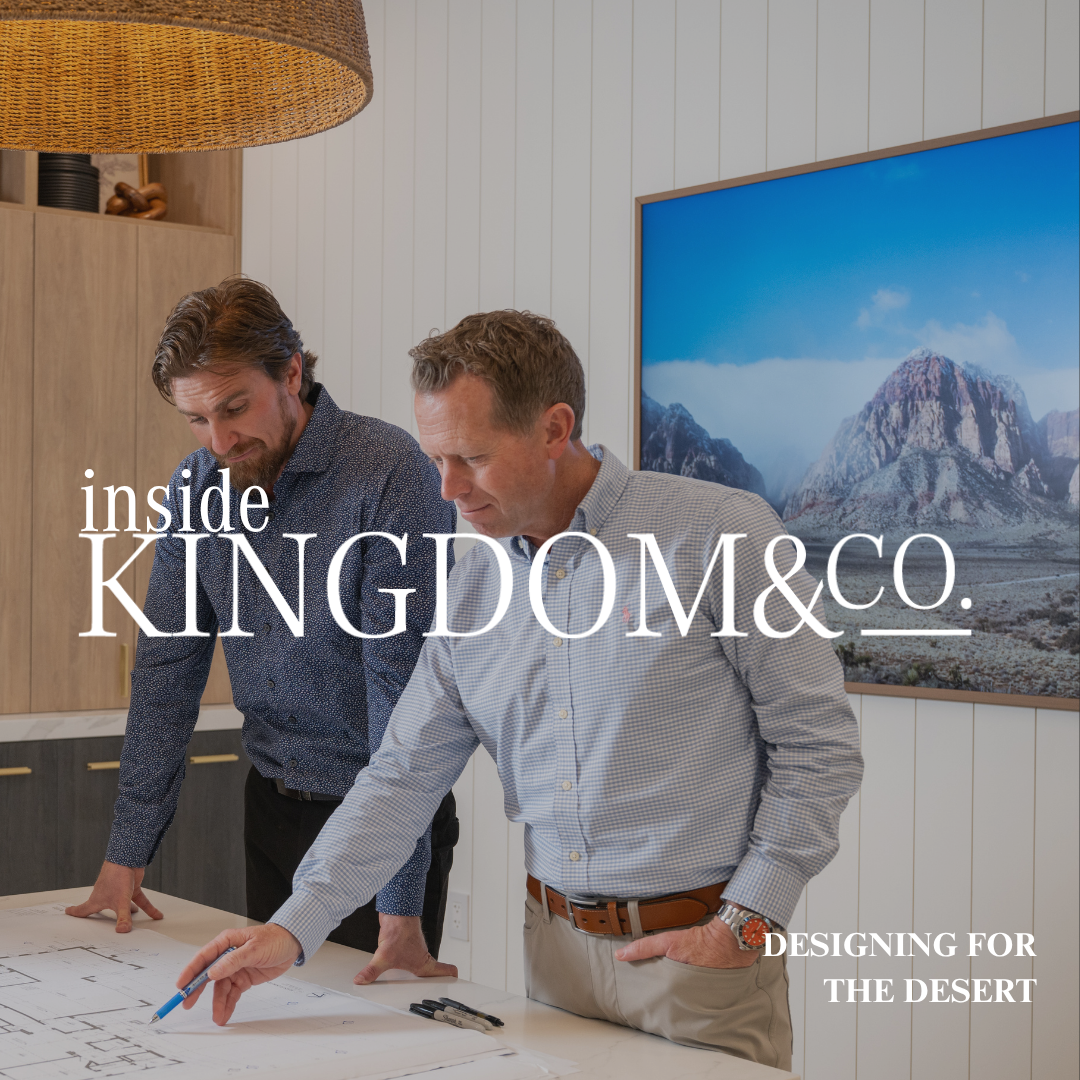
Hosted by Lincoln Rogers and the Kingdom & Co. team, we started this podcast to pull back the curtain on the design-build world. This podcast was born from a desire to bring clarity and confidence to a process that often feels overwhelming. Whether you're renovating, building from the ground up, or simply exploring your options, we're here to offer refined insight and trusted guidance. From navigating timelines and budgets to understanding design choices and construction challenges, this podcast is your guide to a smoother, smarter experience from concept to completion.
Designing For The Desert | Inside Kingdom & Co. Podcast
Zion: All right, today we’re gonna be talking about designing for the desert.
So I’m here with John McDonough.
Let’s start off, I think one of the first things when you enter the design phase, let’s talk orientation.
When somebody is planning on designing a home in the desert, what do they need to be aware of when it comes to orientation?
John: Yeah, really good question.
Just because we get that intense east-west exposure and sun.
You know, it’s challenging because if you buy a lot that faces east-west and you’re facing the street and you have to fit, you can’t turn your house a certain angle by the HOA, then you’re obviously stuck with that challenge that you’ve gotta do it.
In the design part of that, you need to make sure that overhangs, window size, you take all that into account when you’re designing that home.
Because the last thing you wanna be doing is sitting in a family room, a kitchen, a living room somewhere, and you’ve got these gigantic windows looking at the west and the sun’s going down and you’re getting baked.
So you have to put a lot of time and effort into that exposure of how you’re gonna orient the house, how you’re gonna orient the rooms, and what you’re gonna do so that you don’t get killed with the sun exposure.
Zion: That comes to lot orientation if you’re working with a view, and then, yeah, how you design the house around how that sun is gonna be.
What’s really cool now is the software right now, you can simulate all that kind of stuff.
So you can simulate the shadows that the roof line is casting.
You can simulate all of that stuff and how that home is gonna get exposed to the sun at different parts of the year.
John: Yeah, I love that.
And they can literally take that 3D model and show you spring, fall, winter, summer, and the sun at the different points where it is in the day and show you how much exposure you’re getting in the house.
So, like I said, you’ve really got to design it with some overhangs over big windows.
You’ve gotta design it where, you know, you wanna take advantage of the view, so you want those windows, but you have to protect those windows so that you’re not getting the furniture in that room exposed to sun all afternoon long.
Zion: Exactly.
That could even change the tint of your flooring.
John: Totally.
We’ve had that happen.
Zion: Yeah, if you get windows in the wrong spot at the wrong time of day, you’re gonna start to bleach out your different materials.
John: Yep, I’ve seen it happen.
Zion: It’s gonna matter.
John: And another thing that you have to take into effect, not only is the sun, but the wind.
We get a lot of wind in Vegas.
So up in the developments that are getting built into the hills, McDonnell Highlands, Askiah, you get a lot of wind up there.
Like 40, 50, 60 mile an hour winds at some point.
You have to factor that into the design when you’re designing a house as well.
Zion: A lot of people on Pinterest or just looking around social media, they’re gonna see a lot of materials that are very attractive, but don’t work in our climate.
John: Right.
Zion: What’s the short list of those types of materials?
John: It’s a great discussion just because we get so many clients that will send us, I want my house to look like this and it’s exterior wood siding or cladding.
And I want my front door to be wood.
And we’ll immediately tell them, listen, with the wood, you’re gonna be refinishing that every six months to a year.
It’s gonna split, it’s gonna warp, it’s gonna crack.
Especially noticeable on front doors.
A lot of these looks, you want a wood front door and it’s beautiful in different climates.
But here we can’t do it.
Just because it will literally, with the west exposure, that door will fall apart within two to three years.
And a siding as well.
Like they do have different products now that we’ve been able to use that look like wood that are aluminum.
From a distance you can’t tell it’s wood and you have no warping, tweaking, twisting.
So in our climate, because it’s so dry and the heat is so intense, you really have to try and avoid those wood products on the exterior.
Zion: And sometimes it’s not just the heat, it’s the differential because it gets cold here too.
John: Yeah.
John: And that huge disparity is what’s making that wood and other materials expand, contract, expand, contract.
And stuff starts to move.
With doors or windows, it starts to create openings where you didn’t intend to have an opening.
You have little, and then you get water intrusion, you get other, and you get much bigger problems.
John: Much bigger problems, yeah.
Zion: So generally, we’re wanting to stick and lean towards those materials that can withstand our climate.
And we can guide clients through those decisions.
There’s so many good options now where we can use more durable products that still capture that look that we’re going after that warms up stuff.
So it’s not just concrete and steel and stucco.
There’s really good ways now to warm those things up and bring different textures onto those products.
John: Yeah, I like that.
And I like how you brought up that point that sometimes the contemporary look, which has been pretty much the look the last 10 years of what everybody’s building these days is, can get very cold.
And I sometimes say it feels like an office.
And bringing those warm elements, those wood tones, and I like the mixing the steel, the wood, the stucco.
There’s so many things you can blend together to make it look more warm than just not so cold and rigid.
And that’s so important.
And that’s where the challenge was, more so probably 10 years ago, was we didn’t have all these great products that we have now that look like wood or can handle the weather that we have now, which is great.
Zion: Roof lines matter too.
You touched on it briefly, but creating good overhangs that cast shadows at the right times of day to protect those openings, that’s important.
That gets into even how we design when we do slider doors.
We will use a different style of track if it has, based on the size of overhang that it has.
If I have a track that’s fully enclosed with a big overhang, sorry, if I have an opening that has a nice overhang on it, I can generally get a little more aggressive on my track for a low profile.
I’m not afraid of that water coming in there.
But if I have something that doesn’t have those overhangs, I’m gonna want a much more resilient track that’s gonna shed water.
John: Really good point to talk about just because everybody wants that flush into outside look with no step down.
Nobody wants that lip on the threshold.
But I tell people, if you don’t have an overhang and you don’t have that lip that comes up and protects that water from coming back in, you will get water intrusion.
Zion: Yeah, it’s a huge complaint.
And so there’s, and again, now we’ve developed new systems that you can still get that flush look and feel, but it has, it takes a lot more energy and work to integrate it with a drainage system.
John: Correct.
Zion: And it’s tricky.
It’s tricky.
It takes a lot of foresight to be able to execute that well so that it’s not a ton of maintenance.
John: Yeah, and it still gets the look that the owner wants.
You know, nobody, most people nowadays don’t want that four inch down step coming out of the family room or the kitchen, you know?
So we try and make those areas where they have the big sliders, where we have a covered patio.
Zion: Yeah, exactly.
John: You know, because even if you do an eyebrow or you do a three foot overhang, it’s not gonna protect that door from the, the problem with Vegas, especially when you get into these areas up in the hills, is we get a lot of side wind.
Zion: Yeah, driving rain.
John: And side rain.
Zion: Yeah.
John: So even if you have, you know, a three foot overhang, it’s not gonna protect that door from that driving rain.
Zion: Yeah, rain doesn’t always fall vertically.
John: Right.
Sometimes you get.
Zion: So other things I think designing for a desert, as far as aesthetics, you know, a trend I really like that’s up and coming is kind of this, there’s different names for it, but one name is Tadalac.
You know, they bring in, it’s kind of like a stucco finish, but it’s like an Adobe sort of thing.
But it’s that concrete, earthy, and it’s coming a lot of times into the showers and bathrooms.
John: Oh yeah, yeah.
Zion: And that’s a beautiful look that really is like a desert contemporary look.
We’ve done it on several projects and it’s, to me, it feels so warm, but yet so clean.
John: Yeah.
Zion: And it’s like a perfect blend.
And I see that, that’s a trend I see sticking around for a while.
John: I really like that.
Like it looks like the shower is just part of the exterior and interior of the home combined.
Zion: Yeah.
John: And it doesn’t break.
It doesn’t have the tile edge.
It’s just so clean.
So that is a really good look.
One other thing that to talk about too is exterior landscapes.
We get a lot of people that come from different climates, Northern California, wanna have more of a jungle type look.
And a lot of the plants, obviously just, they won’t grow here.
Zion: Yeah, you can plant them.
They just, you have to keep replacing them.
John: Right.
Zion: Because they don’t survive.
John: Yeah, it’s a challenge though.
Cause people really want that kind of, you know, look that they want.
And we have to tell them that plant’s not gonna make it.
That plant’s not gonna make it.
And it literally won’t, you know.
Makes a huge difference.
Zion: I mean, even in my own house, I feel like, after every summer, there’s usually a, like a 20% loss in whatever I have planted.
John: Yeah, it’s crazy how much you have to maintain it.
Zion: Yeah.
John: And so even with the agaves, that a lot of people want the agaves now.
And we tell them, yeah, they’re great.
I love agaves.
I have them in my own house, but they get the worms in them.
So you have to maintain them.
So there’s just a lot of things you gotta factor in into this Vegas environment that a lot of people aren’t familiar with in other climates.
Zion: And especially as the community grows, the city grows, you know, there’s more and more water restrictions.
They’re more and more, you know, cracking down on any sort of water over usage, it seems like.
And yeah, so you’ve got to design around that.
John: Totally.
And the pools have to be smaller now.
They have the stipulations in Vegas, 600 square feet.
So you, it’s challenging when you have a three quarter acre lot and a big house, and you’ve got a huge backyard and you have to put a 20 by 30 pool.
So that takes a lot of architectural coordination too, with the landscape architects to make sure that this pool doesn’t look like it’s way undersized for the backyard.
Zion: Yeah.
John: And the way that you can accomplish that is by creating sitting areas, hardscape areas, that destination sites in the backyard so the pool doesn’t feel so small, like it’s part of this little area over here.
Versus the old days, you’d build a big pool and it fit the backyard and the house.
Now it’s a little bit more challenging with these restrictions.
Zion: Yeah, that’s a really good insight.
There’s gonna be moments where, hey, getting, we need light in this area, getting glass here, and it’s west facing or south facing, and it’s inevitable.
Then you can offset and mitigate that risk by the shade pockets that you build.
So we can, you know, we should talk about properly planning for shades.
And there’s a huge difference in my mind between a motorized shade and when it’s well executed versus having to go over there every time and, you know, pull down on a chain to get, because you’re gonna forget, or you’re not gonna be, you’re gonna be gone.
So, gosh, I think they even have some products now that will actually are intuitive, that actually will read that sun and will then.
John: Yeah, I haven’t done any of those, but I have heard that.
The one thing that takes a lot of coordination and planning is the shade pockets.
People don’t realize that, that when you’re designing your trusses and designing the house, if you want a shade pocket that’s up in the ceiling, most of the, some of these shade pockets, when you do a dual shade pocket, meaning you have a blackout shade and a sheer shade, they can use 12 by 12 pockets.
So there is certain instances as homes where we don’t have that 12 by 12 space up in the attic if it’s the end of a tail.
So at those cases, we have to plan that out in advance and say, okay, we can do shade pockets in these areas, but we can’t.
So that’s a discussion with the truss manufacturer before you get those trusses made and your interior designer to make sure they’re gonna be okay with some of those shade pockets being mounted to the window or in the pocket of the window instead of up in the ceiling.
Zion: It all loops back to do not start a project and design it as you go.
John: Correct.
It’s gonna be so expensive.
Have the foresight, have the right team that makes those decisions ahead of time, because just something like that has huge structural implications and there’s nothing cheap about a structural mistake.
John: No, like that, if you wanna come in and put a shade pocket in after the fact, it’s a big deal.
Zion: Yeah.
John: You’re getting your truss engineer involved, you’re fixing trusses, you gotta do a repair to the county or city.
So it takes a lot of coordination and that’s stuff that needs to be done before the shovel gets put in the ground.
Zion: Yeah.
John: And there’s a lot of coordination, a lot of coordination that has to go into these projects before you start the project.
And to make it right.
Zion: Yeah.
John: To make it so that when you walk through, it looks like everything was so thought out in that house.
Yeah, it makes a huge difference in the feel of the home.
Zion: Right.
John: One of the other things too on talking about the shades is we’ve done a few exterior polar shades they’re called.
And it’s a shade that’s outside like on the columns of a patio.
Zion: Yeah, I have seen those.
John: And that way it can come down in the afternoons if you do want that view looking out your family room and you have a West facing lot, you’re like, I gotta have this view.
I want these 24 foot pocket doors, 12 foot tall, I want that view.
And what are we gonna do to block that sun?
Zion: Yeah.
John: Well, what we’ve done on a couple houses is out on the exterior columns of the patio, we have a shade that drops down and it was automated, like you said a little bit earlier, where it came down at certain points of the day.
Zion: Yes.
John: And you can see through it still, but it takes that heat off the family room or window.
Zion: Yeah, it definitely reduces the intensity.
John: Correct, a lot.
So it’s tolerable.
Zion: The challenge with those, once again, we tell people this is with the winds come up, you can’t have that shade down because it’ll rip the shade.
Batten down the sails.
John: Yeah, exactly.
Zion: All right, so again, if you’re considering a new project, a new build or a remodel, give us a call.
We’ll work with you directly and really get those details in place.
That’s what we do best so that your project looks amazing.
Zion: All right, today we’re gonna be talking about designing for the desert.
So I’m here with John McDonough.
Let’s start off, I think one of the first things when you enter the design phase, let’s talk orientation.
When somebody is planning on designing a home in the desert, what do they need to be aware of when it comes to orientation?
John: Yeah, really good question.
Just because we get that intense east-west exposure and sun.
You know, it’s challenging because if you buy a lot that faces east-west and you’re facing the street and you have to fit, you can’t turn your house a certain angle by the HOA, then you’re obviously stuck with that challenge that you’ve gotta do it.
In the design part of that, you need to make sure that overhangs, window size, you take all that into account when you’re designing that home.
Because the last thing you wanna be doing is sitting in a family room, a kitchen, a living room somewhere, and you’ve got these gigantic windows looking at the west and the sun’s going down and you’re getting baked.
So you have to put a lot of time and effort into that exposure of how you’re gonna orient the house, how you’re gonna orient the rooms, and what you’re gonna do so that you don’t get killed with the sun exposure.
Zion: That comes to lot orientation if you’re working with a view, and then, yeah, how you design the house around how that sun is gonna be.
What’s really cool now is the software right now, you can simulate all that kind of stuff.
So you can simulate the shadows that the roof line is casting.
You can simulate all of that stuff and how that home is gonna get exposed to the sun at different parts of the year.
John: Yeah, I love that.
And they can literally take that 3D model and show you spring, fall, winter, summer, and the sun at the different points where it is in the day and show you how much exposure you’re getting in the house.
So, like I said, you’ve really got to design it with some overhangs over big windows.
You’ve gotta design it where, you know, you wanna take advantage of the view, so you want those windows, but you have to protect those windows so that you’re not getting the furniture in that room exposed to sun all afternoon long.
Zion: Exactly.
That could even change the tint of your flooring.
John: Totally.
We’ve had that happen.
Zion: Yeah, if you get windows in the wrong spot at the wrong time of day, you’re gonna start to bleach out your different materials.
John: Yep, I’ve seen it happen.
Zion: It’s gonna matter.
John: And another thing that you have to take into effect, not only is the sun, but the wind.
We get a lot of wind in Vegas.
So up in the developments that are getting built into the hills, McDonnell Highlands, Askiah, you get a lot of wind up there.
Like 40, 50, 60 mile an hour winds at some point.
You have to factor that into the design when you’re designing a house as well.
Zion: A lot of people on Pinterest or just looking around social media, they’re gonna see a lot of materials that are very attractive, but don’t work in our climate.
John: Right.
Zion: What’s the short list of those types of materials?
John: It’s a great discussion just because we get so many clients that will send us, I want my house to look like this and it’s exterior wood siding or cladding.
And I want my front door to be wood.
And we’ll immediately tell them, listen, with the wood, you’re gonna be refinishing that every six months to a year.
It’s gonna split, it’s gonna warp, it’s gonna crack.
Especially noticeable on front doors.
A lot of these looks, you want a wood front door and it’s beautiful in different climates.
But here we can’t do it.
Just because it will literally, with the west exposure, that door will fall apart within two to three years.
And a siding as well.
Like they do have different products now that we’ve been able to use that look like wood that are aluminum.
From a distance you can’t tell it’s wood and you have no warping, tweaking, twisting.
So in our climate, because it’s so dry and the heat is so intense, you really have to try and avoid those wood products on the exterior.
Zion: And sometimes it’s not just the heat, it’s the differential because it gets cold here too.
John: Yeah.
John: And that huge disparity is what’s making that wood and other materials expand, contract, expand, contract.
And stuff starts to move.
With doors or windows, it starts to create openings where you didn’t intend to have an opening.
You have little, and then you get water intrusion, you get other, and you get much bigger problems.
John: Much bigger problems, yeah.
Zion: So generally, we’re wanting to stick and lean towards those materials that can withstand our climate.
And we can guide clients through those decisions.
There’s so many good options now where we can use more durable products that still capture that look that we’re going after that warms up stuff.
So it’s not just concrete and steel and stucco.
There’s really good ways now to warm those things up and bring different textures onto those products.
John: Yeah, I like that.
And I like how you brought up that point that sometimes the contemporary look, which has been pretty much the look the last 10 years of what everybody’s building these days is, can get very cold.
And I sometimes say it feels like an office.
And bringing those warm elements, those wood tones, and I like the mixing the steel, the wood, the stucco.
There’s so many things you can blend together to make it look more warm than just not so cold and rigid.
And that’s so important.
And that’s where the challenge was, more so probably 10 years ago, was we didn’t have all these great products that we have now that look like wood or can handle the weather that we have now, which is great.
Zion: Roof lines matter too.
You touched on it briefly, but creating good overhangs that cast shadows at the right times of day to protect those openings, that’s important.
That gets into even how we design when we do slider doors.
We will use a different style of track if it has, based on the size of overhang that it has.
If I have a track that’s fully enclosed with a big overhang, sorry, if I have an opening that has a nice overhang on it, I can generally get a little more aggressive on my track for a low profile.
I’m not afraid of that water coming in there.
But if I have something that doesn’t have those overhangs, I’m gonna want a much more resilient track that’s gonna shed water.
John: Really good point to talk about just because everybody wants that flush into outside look with no step down.
Nobody wants that lip on the threshold.
But I tell people, if you don’t have an overhang and you don’t have that lip that comes up and protects that water from coming back in, you will get water intrusion.
Zion: Yeah, it’s a huge complaint.
And so there’s, and again, now we’ve developed new systems that you can still get that flush look and feel, but it has, it takes a lot more energy and work to integrate it with a drainage system.
John: Correct.
Zion: And it’s tricky.
It’s tricky.
It takes a lot of foresight to be able to execute that well so that it’s not a ton of maintenance.
John: Yeah, and it still gets the look that the owner wants.
You know, nobody, most people nowadays don’t want that four inch down step coming out of the family room or the kitchen, you know?
So we try and make those areas where they have the big sliders, where we have a covered patio.
Zion: Yeah, exactly.
John: You know, because even if you do an eyebrow or you do a three foot overhang, it’s not gonna protect that door from the, the problem with Vegas, especially when you get into these areas up in the hills, is we get a lot of side wind.
Zion: Yeah, driving rain.
John: And side rain.
Zion: Yeah.
John: So even if you have, you know, a three foot overhang, it’s not gonna protect that door from that driving rain.
Zion: Yeah, rain doesn’t always fall vertically.
John: Right.
Sometimes you get.
Zion: So other things I think designing for a desert, as far as aesthetics, you know, a trend I really like that’s up and coming is kind of this, there’s different names for it, but one name is Tadalac.
You know, they bring in, it’s kind of like a stucco finish, but it’s like an Adobe sort of thing.
But it’s that concrete, earthy, and it’s coming a lot of times into the showers and bathrooms.
John: Oh yeah, yeah.
Zion: And that’s a beautiful look that really is like a desert contemporary look.
We’ve done it on several projects and it’s, to me, it feels so warm, but yet so clean.
John: Yeah.
Zion: And it’s like a perfect blend.
And I see that, that’s a trend I see sticking around for a while.
John: I really like that.
Like it looks like the shower is just part of the exterior and interior of the home combined.
Zion: Yeah.
John: And it doesn’t break.
It doesn’t have the tile edge.
It’s just so clean.
So that is a really good look.
One other thing that to talk about too is exterior landscapes.
We get a lot of people that come from different climates, Northern California, wanna have more of a jungle type look.
And a lot of the plants, obviously just, they won’t grow here.
Zion: Yeah, you can plant them.
They just, you have to keep replacing them.
John: Right.
Zion: Because they don’t survive.
John: Yeah, it’s a challenge though.
Cause people really want that kind of, you know, look that they want.
And we have to tell them that plant’s not gonna make it.
That plant’s not gonna make it.
And it literally won’t, you know.
Makes a huge difference.
Zion: I mean, even in my own house, I feel like, after every summer, there’s usually a, like a 20% loss in whatever I have planted.
John: Yeah, it’s crazy how much you have to maintain it.
Zion: Yeah.
John: And so even with the agaves, that a lot of people want the agaves now.
And we tell them, yeah, they’re great.
I love agaves.
I have them in my own house, but they get the worms in them.
So you have to maintain them.
So there’s just a lot of things you gotta factor in into this Vegas environment that a lot of people aren’t familiar with in other climates.
Zion: And especially as the community grows, the city grows, you know, there’s more and more water restrictions.
They’re more and more, you know, cracking down on any sort of water over usage, it seems like.
And yeah, so you’ve got to design around that.
John: Totally.
And the pools have to be smaller now.
They have the stipulations in Vegas, 600 square feet.
So you, it’s challenging when you have a three quarter acre lot and a big house, and you’ve got a huge backyard and you have to put a 20 by 30 pool.
So that takes a lot of architectural coordination too, with the landscape architects to make sure that this pool doesn’t look like it’s way undersized for the backyard.
Zion: Yeah.
John: And the way that you can accomplish that is by creating sitting areas, hardscape areas, that destination sites in the backyard so the pool doesn’t feel so small, like it’s part of this little area over here.
Versus the old days, you’d build a big pool and it fit the backyard and the house.
Now it’s a little bit more challenging with these restrictions.
Zion: Yeah, that’s a really good insight.
There’s gonna be moments where, hey, getting, we need light in this area, getting glass here, and it’s west facing or south facing, and it’s inevitable.
Then you can offset and mitigate that risk by the shade pockets that you build.
So we can, you know, we should talk about properly planning for shades.
And there’s a huge difference in my mind between a motorized shade and when it’s well executed versus having to go over there every time and, you know, pull down on a chain to get, because you’re gonna forget, or you’re not gonna be, you’re gonna be gone.
So, gosh, I think they even have some products now that will actually are intuitive, that actually will read that sun and will then.
John: Yeah, I haven’t done any of those, but I have heard that.
The one thing that takes a lot of coordination and planning is the shade pockets.
People don’t realize that, that when you’re designing your trusses and designing the house, if you want a shade pocket that’s up in the ceiling, most of the, some of these shade pockets, when you do a dual shade pocket, meaning you have a blackout shade and a sheer shade, they can use 12 by 12 pockets.
So there is certain instances as homes where we don’t have that 12 by 12 space up in the attic if it’s the end of a tail.
So at those cases, we have to plan that out in advance and say, okay, we can do shade pockets in these areas, but we can’t.
So that’s a discussion with the truss manufacturer before you get those trusses made and your interior designer to make sure they’re gonna be okay with some of those shade pockets being mounted to the window or in the pocket of the window instead of up in the ceiling.
Zion: It all loops back to do not start a project and design it as you go.
John: Correct.
It’s gonna be so expensive.
Have the foresight, have the right team that makes those decisions ahead of time, because just something like that has huge structural implications and there’s nothing cheap about a structural mistake.
John: No, like that, if you wanna come in and put a shade pocket in after the fact, it’s a big deal.
Zion: Yeah.
John: You’re getting your truss engineer involved, you’re fixing trusses, you gotta do a repair to the county or city.
So it takes a lot of coordination and that’s stuff that needs to be done before the shovel gets put in the ground.
Zion: Yeah.
John: And there’s a lot of coordination, a lot of coordination that has to go into these projects before you start the project.
And to make it right.
Zion: Yeah.
John: To make it so that when you walk through, it looks like everything was so thought out in that house.
Yeah, it makes a huge difference in the feel of the home.
Zion: Right.
John: One of the other things too on talking about the shades is we’ve done a few exterior polar shades they’re called.
And it’s a shade that’s outside like on the columns of a patio.
Zion: Yeah, I have seen those.
John: And that way it can come down in the afternoons if you do want that view looking out your family room and you have a West facing lot, you’re like, I gotta have this view.
I want these 24 foot pocket doors, 12 foot tall, I want that view.
And what are we gonna do to block that sun?
Zion: Yeah.
John: Well, what we’ve done on a couple houses is out on the exterior columns of the patio, we have a shade that drops down and it was automated, like you said a little bit earlier, where it came down at certain points of the day.
Zion: Yes.
John: And you can see through it still, but it takes that heat off the family room or window.
Zion: Yeah, it definitely reduces the intensity.
John: Correct, a lot.
So it’s tolerable.
Zion: The challenge with those, once again, we tell people this is with the winds come up, you can’t have that shade down because it’ll rip the shade.
Batten down the sails.
John: Yeah, exactly.
Zion: All right, so again, if you’re considering a new project, a new build or a remodel, give us a call.
We’ll work with you directly and really get those details in place.
That’s what we do best so that your project looks amazing.
Inside Kingdom & Co.
Hosted by Lincoln Rogers and the Kingdom & Co. team, we started this podcast to pull back the curtain on the design-build world. This podcast was born from a desire to bring clarity and confidence to a process that often feels overwhelming. Whether you're renovating, building from the ground up, or simply exploring your options, we're here to offer refined insight and trusted guidance. From navigating timelines and budgets to understanding design choices and construction challenges, this podcast is your guide to a smoother, smarter experience from concept to completion.